Work and spinning commitments (samples and swatches for two different workshops, plus prep for teaching) take up a lot of time at present, but when time and thought processes allow, I am thinking about weaving. On occasion when I've said that before, Someone has told me to spend less time thinking, more time doing (or words to that effect). Lately I've also been thinking about why I'm thinking about weaving, which has led me to think about how I learn and how I create.
To recap: it seemed everyone was weaving nice useful cotton towels, so I thought buying a towel kit was a good plan. No difficult yarn choice, instructions provided - I should be able to just warp and weave. But the kit colours were more garish than the photos suggested, I couldn't get a true plain weave interlacement, samples woven at the suggested epi were sleazy, the bobbins would hiccup and pull the selvedge out of true. The entire thing was terribly disheartening, the more so because there are so many factors I don't necessarily recognise, let alone understand and so many other things my mind and hands have to learn to do together. So after the last sample the loom has sat unsleyed while I thought about what I was trying to achieve. 'Just do it' can be a good plan; it has served me well many times in the past, but has only proved totally reliable for simple tasks or those that require pre-existing skills. I tried 'just do it' with the cotton warp, and it failed me, so now I am Thinking. And Researching. I suspect I am far more ignorant than you realise, you other weavers. For example, I didn't know about Anne Dixon's Four-Shaft pattern directory until last week. Now that I have a copy, I begin to see a way forward with that warp and, in seeing it, I think I have learned something significant about myself and my creativity. I suspect part of my problem is that I've been trying to make something by following the instructions exactly, on the grounds that I'll learn by doing. But 'following instructions' is not creating, in my terms. It's unsatisfying. It's a challenge in the sense that a long, long uphill climb is a challenge: one foot in front of the other for hours on end - but at least at the end of the climb there will be a view! The end result of those instructions is not to my taste: I don't like the colours, I don't like the stripes revealed by my nearest approximation to plain weave. That fabric doesn't inspire me to weave more.
And yet I am constantly thinking about weaving. I am thinking through the issues of warping with handspun cotton singles, imagining fabrics made with the yarns I have to hand, looking at what people are wearing in the supermarket, how the fabric drapes, how the garments are cut. And it just struck me that this is very like the way I approach some of my more daunting professional creative projects. When I don't know how to tackle a project, I circle around it, find different ways to approach and understand facets of the problem and, at the same time, I set the entire thing to simmer on some back burner in my brain. There's a creative impulse driving me to weave, not a desire to follow instructions that make my hands make bad ugly cloth. I want to weave the fabrics I see in my head. They're not plainweave orange-and-purple stripes, they're sultry dark plum, burgundy and indigo twills shot with silk. Sunlight on autumn leaves, re-created as fabric; winter sky seen through blackthorn branches sparkling with snow. My own handspun cotton denim, woven to an 18th century pattern. Each of these is something I have fibre or yarn for. I don't care that warping with handspun cotton singles may make me want to kill something (if only an entire bottle of wine), because I am absolutely certain that if I persevere with it, I will make something worthwhile that is entirely mine.
On the other hand I hate to waste the warp that's on the loom. It's taught me a lot already - I've made more mistakes with it than I thought possible - and I'm fairly sure it can teach me more. But not as garish nearly-plain weave stripes! (sorry, you stripe-lovers). So isn't it fortunate that my one departure from the kit instructions was to thread it for a straight twill? Anne Dixon shows lots of things I can do with that. I may make one more attempt at plain weave to test one more theory. And after watching Madeleine van der Hoogt's weaving tips video I think I know why the bobbins hiccup. So much to learn...
All those words and no pictures except perhaps in your heads. Sorry. I'll do better next time, promise!
Wednesday, February 29, 2012

Thursday, February 23, 2012
Details, Details
I promised you photos of the washed and unwashed gaudy scarf. Here's the unwashed scarf:

And here's the washed scarf:

Indeed, a little more movement of the yarns after washing. (And you two are being very ... discreet about this display of utter gaudiness!)
I also made my very first yarn wrappings ever with the yarns I spun last year and talked about in my earlier post. The first one has all six yarns, in proportion to the amount of each yarn I have, wound on more-or-less randomly. That is, I took one strand each of the four Abstract Fibers yarns (I had 4 oz. of each of those), four strands of the Briar Rose (I had a pound of that), and four strands of the Rovings yarn (also a pound of this), and wound them in a bunch onto the cardboard. Then, I spread out the yarns to a single layer. Clear as mud, I'm sure. Anyhow, here 'tis:

Now, I wasn't sure about the paleness of the Briar Rose, so I decided to make a wrapping that mimics what it might look like if I overdye the Briar Rose to a darker purple. This wrapping has 1 strand each of the Abstract Fibers and 4 strands of the Rovings:

Frankly, I think the second wrapping is dull. On the other hand, I keep changing my mind. I think what I need to do is make the muslin in commercial fabric, so I can figure out exactly how much fabric I need to weave. With any luck, I'll need less than the full three pounds, so I can weave a few samples with the extra before I plunge into all 8 yards.
Or maybe I'll just spin more yarn!
And here's the washed scarf:
Indeed, a little more movement of the yarns after washing. (And you two are being very ... discreet about this display of utter gaudiness!)
I also made my very first yarn wrappings ever with the yarns I spun last year and talked about in my earlier post. The first one has all six yarns, in proportion to the amount of each yarn I have, wound on more-or-less randomly. That is, I took one strand each of the four Abstract Fibers yarns (I had 4 oz. of each of those), four strands of the Briar Rose (I had a pound of that), and four strands of the Rovings yarn (also a pound of this), and wound them in a bunch onto the cardboard. Then, I spread out the yarns to a single layer. Clear as mud, I'm sure. Anyhow, here 'tis:
Now, I wasn't sure about the paleness of the Briar Rose, so I decided to make a wrapping that mimics what it might look like if I overdye the Briar Rose to a darker purple. This wrapping has 1 strand each of the Abstract Fibers and 4 strands of the Rovings:
Frankly, I think the second wrapping is dull. On the other hand, I keep changing my mind. I think what I need to do is make the muslin in commercial fabric, so I can figure out exactly how much fabric I need to weave. With any luck, I'll need less than the full three pounds, so I can weave a few samples with the extra before I plunge into all 8 yards.
Or maybe I'll just spin more yarn!
Wednesday, February 22, 2012
Getting Ready
So you all know that I'll be taking a garment class with Jeane deCoster of Elemental Affects fame. The first workshop is next weekend and she's sent out the agenda and plan for the first two days. Suffice to say, there'll be *lots* to think about. I have two, ok, THREE garments in mind for the class so I thought I'd take a moment to share those and get your feedback. Oh, and I've already fallen down at Webs to buy a bunch of yarn (had some money in the shop account that needed spending) for this and even if it's not the exact thing, it should be a great place to start.
1. Sara's Kimono
I'll be bringing the first one with me - first of all, to share the fabric. Second, I'd like folks to help me think about what I did/didn't do that can make the garment better. The first one was in 8/2 cotton and I think the fabric was *good*. It just might be better either in a different material, different gauge or otherwise.
2. The Two Piece Tunic
I found some cute cotton fabric that I had lying about from my skirt-attempting days and that's in the washer now in hopes of getting it cut and sewn before class. It should only take a couple hours, all-in, so we'll see how that goes. I'd also like to get a bit of the cotton fabric woven off before class, but I'm not sure I'll make it. Perhaps that'll be my project while down there since we'll be warping for A Thing as part of the weekend.
3. Burda Dress
I really, *really like this dress. I'll save you a few clicks by putting the picture here:

Isn't it adoreable? I think it would work well in a lightweight wool (why yes, I did fall down and buy a bunch of the 8/2 Mill Ends - darn you, Lynn!), perhaps a twill or even a log cabin and it certainly would be great in a linen or cotton. The latter would want a lining but the former might do well without. Anyway, I find this to be simple yet elegant and absolutely something I'd wear ALL.THE.TIME. Can't you see it with a turtleneck sweater underneath, some tights and clogs? Or, in a different fabric, as a nice light-weight dress for dinner in the summertime. It can be casual, it can be formal, I think it's just classic and great. Heck, I can split the pattern and make both a bodice *and* a pencil-skirt. I think this is going to be $10 well-spent.
So, I've enhanced my stash with 8/2 wool, 10/2 cotton and 20/2 cotton. Between those three, I'm likely to be able to get three fabrics that would work great with the three garments. I'm going to save the handspun for later.
Today's activities, on the other hand, included rebuilding the online shop since all my products had mysteriously disappeared (thanks to Marcy for pointing it out) and then getting the warp for the dishtowels going. Still two scarves and 6# of fiber left to dye. I might make that 7# because one of the skeins looks a little dodgy. It's a nice day though so my 7.5 mile run should be a treat.
How are you two doing?
1. Sara's Kimono
I'll be bringing the first one with me - first of all, to share the fabric. Second, I'd like folks to help me think about what I did/didn't do that can make the garment better. The first one was in 8/2 cotton and I think the fabric was *good*. It just might be better either in a different material, different gauge or otherwise.
2. The Two Piece Tunic
I found some cute cotton fabric that I had lying about from my skirt-attempting days and that's in the washer now in hopes of getting it cut and sewn before class. It should only take a couple hours, all-in, so we'll see how that goes. I'd also like to get a bit of the cotton fabric woven off before class, but I'm not sure I'll make it. Perhaps that'll be my project while down there since we'll be warping for A Thing as part of the weekend.
3. Burda Dress
I really, *really like this dress. I'll save you a few clicks by putting the picture here:
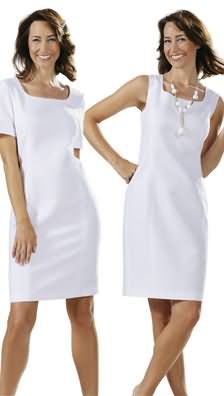
Isn't it adoreable? I think it would work well in a lightweight wool (why yes, I did fall down and buy a bunch of the 8/2 Mill Ends - darn you, Lynn!), perhaps a twill or even a log cabin and it certainly would be great in a linen or cotton. The latter would want a lining but the former might do well without. Anyway, I find this to be simple yet elegant and absolutely something I'd wear ALL.THE.TIME. Can't you see it with a turtleneck sweater underneath, some tights and clogs? Or, in a different fabric, as a nice light-weight dress for dinner in the summertime. It can be casual, it can be formal, I think it's just classic and great. Heck, I can split the pattern and make both a bodice *and* a pencil-skirt. I think this is going to be $10 well-spent.
So, I've enhanced my stash with 8/2 wool, 10/2 cotton and 20/2 cotton. Between those three, I'm likely to be able to get three fabrics that would work great with the three garments. I'm going to save the handspun for later.
Today's activities, on the other hand, included rebuilding the online shop since all my products had mysteriously disappeared (thanks to Marcy for pointing it out) and then getting the warp for the dishtowels going. Still two scarves and 6# of fiber left to dye. I might make that 7# because one of the skeins looks a little dodgy. It's a nice day though so my 7.5 mile run should be a treat.
How are you two doing?
Sunday, February 19, 2012
Something Completely Different
When last we left our anti-heroine...

I'll spare you the gore.
I'm not in the slightest sad/frustrated/guilty/whatever about that warp; my time is the resource in short supply around here, so trying another warp was the quickest way of straightening this all out.
Since I wanted to try another warp, I wanted yarns that were thicker than the 2/10 Merino/Tencel, so I'd have fewer ends for a scarf and winding/sleying/threading/tying-on would go quicker. Somehow, two yarns that have been in my knitting yarn stash for several years came to mind. They were thicker ... but rather definitely not sedate.

Yes, that really is mostly bright pink. The pink is Hand Maiden Ottawa in the Dragonfly colorway (gee, I can't imagine why I was attracted to this). It's a single, 92% wool, 8% rayon. Despite being a single, this yarn behaved like a champ in the warp - just one end broke, at a spot where it wasn't twisted enough. The darker yarn is Cherry Tree Hill Oceania in the Quarry Hill colorway, which is a wool boucle with a strand of Lurex running through it. This also behaved perfectly in the warp.
So, I wound off the 100 ends needed for a scarf last night, and this morning I dressed the loom. Both yarns were about 18 wpi, so I figured that an ordinary tabby sett of 10 epi would be convenient, since I have a 10-dent reed.
Once again, I was trying to weave a honeycomb variation from the March/April 2009 issue of Handwoven, an article by Rosalie Neilson using a draft from Peter Collingwood. The article gives two treadlings; I used the Ovals treadling. This honeycomb variant creates areas of plain weave (where the warp is crammed), alternating in a checkerboard fashion with areas where weft floats are enclosed by warp floats (where the warp is spaced).
Attempt #1:

The solid red yarn is just to space the warp. It's hard to see with all the yarn texture and colors going on, but there were long weft floats NOT enclosed by the warp. Poop.
Attempt #2, wherein I remembered that harness #3 as seen from the back of the loom as I was threading is harness #2 as seen from the front, and I retie up the treadles (the pattern calls for every other pick to be just harness #3):

Still with the unwanted floats. Grr.
I thought. I stared. I checked for errata (nope). I pulled up harnesses till I got the warp ends to do what I wanted - and lo!

See how there are spots where long warp floats go over the weft? That's what it's supposed to look like. Success!
I started making real progress:

A few hours (and a long walk and dinner) later, it's off the loom!

I am inordinately pleased with myself. In fact, the draft in Handwoven is wrong. Essentially, the treadling in the article says this: 1+3, 3, 1+3, repeat (that's not quite correct, but close enough for my point). What I had to treadle to weave cloth that looks like the photos and doesn't have long weft floats was this: 1+3, 2+3, 1+3. Apparently, a 2 was missing in the tie-up block of the draft.
I am also quite, quite pleased with the scarf. It's nicely wooly, with a complexity of color and texture that I really like. I might have to revamp my wardrobe entirely to accommodate this sparkly, bright pink scarf!
I've still got to twist the fringe and wash it, which should allow the floats to move around even more than they already are, and I'll post a photo of that as well.
Have I mentioned I love weaving?
I'll spare you the gore.
I'm not in the slightest sad/frustrated/guilty/whatever about that warp; my time is the resource in short supply around here, so trying another warp was the quickest way of straightening this all out.
Since I wanted to try another warp, I wanted yarns that were thicker than the 2/10 Merino/Tencel, so I'd have fewer ends for a scarf and winding/sleying/threading/tying-on would go quicker. Somehow, two yarns that have been in my knitting yarn stash for several years came to mind. They were thicker ... but rather definitely not sedate.
Yes, that really is mostly bright pink. The pink is Hand Maiden Ottawa in the Dragonfly colorway (gee, I can't imagine why I was attracted to this). It's a single, 92% wool, 8% rayon. Despite being a single, this yarn behaved like a champ in the warp - just one end broke, at a spot where it wasn't twisted enough. The darker yarn is Cherry Tree Hill Oceania in the Quarry Hill colorway, which is a wool boucle with a strand of Lurex running through it. This also behaved perfectly in the warp.
So, I wound off the 100 ends needed for a scarf last night, and this morning I dressed the loom. Both yarns were about 18 wpi, so I figured that an ordinary tabby sett of 10 epi would be convenient, since I have a 10-dent reed.
Once again, I was trying to weave a honeycomb variation from the March/April 2009 issue of Handwoven, an article by Rosalie Neilson using a draft from Peter Collingwood. The article gives two treadlings; I used the Ovals treadling. This honeycomb variant creates areas of plain weave (where the warp is crammed), alternating in a checkerboard fashion with areas where weft floats are enclosed by warp floats (where the warp is spaced).
Attempt #1:
The solid red yarn is just to space the warp. It's hard to see with all the yarn texture and colors going on, but there were long weft floats NOT enclosed by the warp. Poop.
Attempt #2, wherein I remembered that harness #3 as seen from the back of the loom as I was threading is harness #2 as seen from the front, and I retie up the treadles (the pattern calls for every other pick to be just harness #3):
Still with the unwanted floats. Grr.
I thought. I stared. I checked for errata (nope). I pulled up harnesses till I got the warp ends to do what I wanted - and lo!
See how there are spots where long warp floats go over the weft? That's what it's supposed to look like. Success!
I started making real progress:
A few hours (and a long walk and dinner) later, it's off the loom!
I am inordinately pleased with myself. In fact, the draft in Handwoven is wrong. Essentially, the treadling in the article says this: 1+3, 3, 1+3, repeat (that's not quite correct, but close enough for my point). What I had to treadle to weave cloth that looks like the photos and doesn't have long weft floats was this: 1+3, 2+3, 1+3. Apparently, a 2 was missing in the tie-up block of the draft.
I am also quite, quite pleased with the scarf. It's nicely wooly, with a complexity of color and texture that I really like. I might have to revamp my wardrobe entirely to accommodate this sparkly, bright pink scarf!
I've still got to twist the fringe and wash it, which should allow the floats to move around even more than they already are, and I'll post a photo of that as well.
Have I mentioned I love weaving?
To fold or not to fold
that is the question.
The next pattern that I'm going to make ('cause it's quick) is the Two-Piece Tunic that I mentioned the other day. I downloaded and printed the pattern to give it a once-over and see what size fabric I really need. I'll be making either a size 4 or size 6 (yeah, she's into the "new" sizing - else I'd be in the 12 - 14 range) so I took a good look at the cutting lines and here's what I see.
The way the back/shoulder piece is cut as a big "U", with a fold down the center of the back so that it can be a single piece. From looking at the pattern, I think I can get away with a piece that's 24" wide after finishing, so that means it should be about 26 or 27" wide on the loom. (Time to get the Gilmore going!) The front/belly piece is narrower than the back, so whatever fold I have for the back will cover the front as well.
The alternative is to use the front piece as my widest, or cut it on the opposite grain, so that I can weave a narrower piece of fabric. All in, I'll need about 3 yards for the folded pieces, I think more like 4 or 5 yards for the seamed pieces. That means a seam up the back which may affect the drape/structure of the piece.
The fabric will be a spot Bronson that looks like this (look, Ma! PixieLoom!):

and I'll make sure that I use the 1-2-1-2-1 on both edges to get a clean selvedge. Either 11/2 cotton (white on white) or an 8/2 cottolin (need to check the colors) as the yarn. The 11/2 will get sett at 24 and the 8/2 at 20. Spot Bronson should be sett as for plain weave rather than for twill.
So, thoughts? That's hopefully next weekend's project; assuming I get my real work done this week.
The next pattern that I'm going to make ('cause it's quick) is the Two-Piece Tunic that I mentioned the other day. I downloaded and printed the pattern to give it a once-over and see what size fabric I really need. I'll be making either a size 4 or size 6 (yeah, she's into the "new" sizing - else I'd be in the 12 - 14 range) so I took a good look at the cutting lines and here's what I see.
The way the back/shoulder piece is cut as a big "U", with a fold down the center of the back so that it can be a single piece. From looking at the pattern, I think I can get away with a piece that's 24" wide after finishing, so that means it should be about 26 or 27" wide on the loom. (Time to get the Gilmore going!) The front/belly piece is narrower than the back, so whatever fold I have for the back will cover the front as well.
The alternative is to use the front piece as my widest, or cut it on the opposite grain, so that I can weave a narrower piece of fabric. All in, I'll need about 3 yards for the folded pieces, I think more like 4 or 5 yards for the seamed pieces. That means a seam up the back which may affect the drape/structure of the piece.
The fabric will be a spot Bronson that looks like this (look, Ma! PixieLoom!):

and I'll make sure that I use the 1-2-1-2-1 on both edges to get a clean selvedge. Either 11/2 cotton (white on white) or an 8/2 cottolin (need to check the colors) as the yarn. The 11/2 will get sett at 24 and the 8/2 at 20. Spot Bronson should be sett as for plain weave rather than for twill.
So, thoughts? That's hopefully next weekend's project; assuming I get my real work done this week.
Friday, February 17, 2012
Another Learning Opportunity
So, I checked the set-up of the loom with the Merino/Tencel warp tonight. A couple of crossed ends between the heddles and the reed, but no big deal, really. I threw in a spacer-header of some random dark pink cotton and found that getting a shed with this sticky warp was not easy, but certainly not impossible. So far, so good.
The next step was choosing a weft.


I chose the purplish weft to try first. This looks a little wonky, but I actually think it was working fine. This is essentially a plain weave fabric, with every other weft throw being a float that's enclosed by the plain weave ends of one color for a while, then by the plain weave ends of the other color. Since the warp is crammed in the middle of each stripe, the weft is weaving weft-faced plain weave there. In between each strip of color, the warp is spaced waaaay out - in fact, it skips three dents - so there you see the weft.

Then I ducked underneath to check the underside. Oopsie! I know this is not the best photo (you try balancing underneath a loom with an affectionate cat bonking into you), but notice how there are long weft floats showing. There are not long weft floats showing on the top side. There are not supposed to be long weft floats anywhere. Darn.
I think what happened is I screwed up translating the draft (from an article in Handwoven, I don't think I mentioned that) into the sett for this yarn, such that sometimes there's a proper opposite shed between the stripes and sometimes (because I wasn't paying enough attention), there ain't.
So, I need to think about whether this warp is worth saving (meaning should I untie, rethread, and resley?) or should I give up on this sticky yarn and try something else. I'm leaning toward something else right now, but I might sleep on it first.
One of the things I've learned from this is that I need to take the time to do the drawdowns (which Handwoven doesn't show, usually), both for what's shown in the article and for how I want to adapt the draft, so I can be sure I'm getting the effect I want.
The next step was choosing a weft.
I have two choices. Both are a mill end lamb's-wool/nylon, quite soft, that I dyed a while ago, one pinkish, one purplish.
I chose the purplish weft to try first. This looks a little wonky, but I actually think it was working fine. This is essentially a plain weave fabric, with every other weft throw being a float that's enclosed by the plain weave ends of one color for a while, then by the plain weave ends of the other color. Since the warp is crammed in the middle of each stripe, the weft is weaving weft-faced plain weave there. In between each strip of color, the warp is spaced waaaay out - in fact, it skips three dents - so there you see the weft.
Then I ducked underneath to check the underside. Oopsie! I know this is not the best photo (you try balancing underneath a loom with an affectionate cat bonking into you), but notice how there are long weft floats showing. There are not long weft floats showing on the top side. There are not supposed to be long weft floats anywhere. Darn.
I think what happened is I screwed up translating the draft (from an article in Handwoven, I don't think I mentioned that) into the sett for this yarn, such that sometimes there's a proper opposite shed between the stripes and sometimes (because I wasn't paying enough attention), there ain't.
So, I need to think about whether this warp is worth saving (meaning should I untie, rethread, and resley?) or should I give up on this sticky yarn and try something else. I'm leaning toward something else right now, but I might sleep on it first.
One of the things I've learned from this is that I need to take the time to do the drawdowns (which Handwoven doesn't show, usually), both for what's shown in the article and for how I want to adapt the draft, so I can be sure I'm getting the effect I want.
Just a big sample
It's done. Ok, it's not Done done but it's done enough for me to post and start talking about what I learned. Pull up a chair and a beverage. This might take a while.

First of all - it's a nice day, isn't it? Sun is shining and temps are in the mid-50s already. I bet they break 70 down the hill. That means the light is best outside and the hummingbird feeder hook was handy. Also, there's just no way for me to take a good/decent picture by myself so that'll have to wait until Chris gets back from LA. Overall, I think I managed the spirit of the pattern and I'll call the process a success. I'm pretty sure I'll wear this - prolly for knocking around and as a coat/jacket on cool afternoons but, for me, there are some things I need to change. Here's a better picture that shows the garment:

First issue is those big big big sleeves. I am really having a hard time getting them to drape/fall in a way that doesn't look odd. The attach very low on the garment and that's below my waist. Also, there's just a TON of fabric. I've been thinking of putting in a pleat, or maybe a dart or something. Or, going with a more traditional sleeve (square rather than triangular).
Second, those stripes. They fell in all the wrong places and didn't line up the way I wanted. The pleats in the shoulders were driven by the stripes. Upon further review, I should have reversed the fabric (green and purple toward the center, brown toward the shoulder) so that I could have highlighted those colors. Or, the stripes need to be smaller. Or I need to not worry about them. The garment absolutely NEEDS the pleats at the shoulder to give it shape - and somehow I need to figure out a better way to utilize them. That's as much a fabric problem as a garment problem.
Third, honestly, I don't like the colors. They all look a bit sallow now. I want somethign with a lot more life. I think if I'd gone for a pinstripe of while on the dark blue background I'd have been happier. And, with the emphasis on the brown rather than the purple and green, it just looks dull. I'm having a hard time seeing past the colors to embrace the construction. And, while I like the idea of what I did with the button band, I'm not sure that works either.
But - in the "success" category, the fabric behaved(s) like a champ! I mentioned in a comment yesterday that I had to take the seam ripper to it - and I did. A couple of times. In all cases, once the stitches were ripped back, the fabric absolutely healed itself and I challenge you to find where I had to make surgical corrections. It has a lovely drape and really did well in the machine. Note for next time - zig-zag every cut edge as soon as it's cut. Makes for happiness later.
So, there you go. First one done. Already thinking about the second one. There'll be a few more in cotton until my sewing and drafting skills get better, but regardless, this was a full and rewarding learning experience. What do you guys think?

First of all - it's a nice day, isn't it? Sun is shining and temps are in the mid-50s already. I bet they break 70 down the hill. That means the light is best outside and the hummingbird feeder hook was handy. Also, there's just no way for me to take a good/decent picture by myself so that'll have to wait until Chris gets back from LA. Overall, I think I managed the spirit of the pattern and I'll call the process a success. I'm pretty sure I'll wear this - prolly for knocking around and as a coat/jacket on cool afternoons but, for me, there are some things I need to change. Here's a better picture that shows the garment:

First issue is those big big big sleeves. I am really having a hard time getting them to drape/fall in a way that doesn't look odd. The attach very low on the garment and that's below my waist. Also, there's just a TON of fabric. I've been thinking of putting in a pleat, or maybe a dart or something. Or, going with a more traditional sleeve (square rather than triangular).
Second, those stripes. They fell in all the wrong places and didn't line up the way I wanted. The pleats in the shoulders were driven by the stripes. Upon further review, I should have reversed the fabric (green and purple toward the center, brown toward the shoulder) so that I could have highlighted those colors. Or, the stripes need to be smaller. Or I need to not worry about them. The garment absolutely NEEDS the pleats at the shoulder to give it shape - and somehow I need to figure out a better way to utilize them. That's as much a fabric problem as a garment problem.
Third, honestly, I don't like the colors. They all look a bit sallow now. I want somethign with a lot more life. I think if I'd gone for a pinstripe of while on the dark blue background I'd have been happier. And, with the emphasis on the brown rather than the purple and green, it just looks dull. I'm having a hard time seeing past the colors to embrace the construction. And, while I like the idea of what I did with the button band, I'm not sure that works either.
But - in the "success" category, the fabric behaved(s) like a champ! I mentioned in a comment yesterday that I had to take the seam ripper to it - and I did. A couple of times. In all cases, once the stitches were ripped back, the fabric absolutely healed itself and I challenge you to find where I had to make surgical corrections. It has a lovely drape and really did well in the machine. Note for next time - zig-zag every cut edge as soon as it's cut. Makes for happiness later.
So, there you go. First one done. Already thinking about the second one. There'll be a few more in cotton until my sewing and drafting skills get better, but regardless, this was a full and rewarding learning experience. What do you guys think?

Subscribe to:
Posts (Atom)